.png)
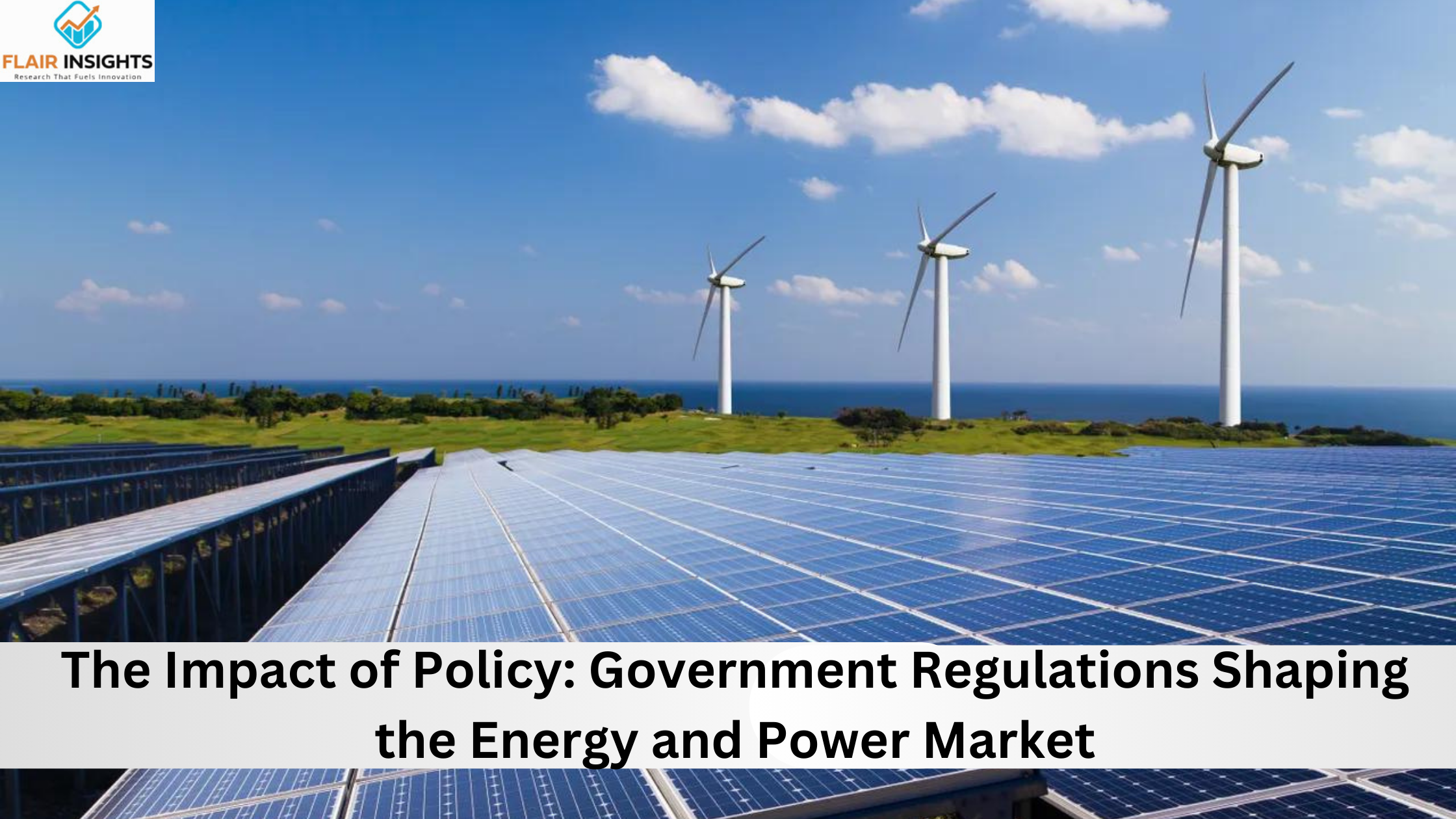
Government regulations therefore take the front seat in shaping the energy and power market amidst a rapidly changing energy environment. In the face of climate change, resource depletion, and sustainable development challenges, countries are using regulatory frameworks as a management tool to push the sector toward a more sustainable and resilient future. The paper examines in detail the complex effect of government policies in the energy and power market, with an emphasis on renewable energy mandates, carbon pricing, energy efficiency standards, grid modernization, socioeconomic implications, and general considerations for economic development.
Renewable Energy Mandates and Incentives:
1.1 Mandates Driving Innovation:
Across the world, governments are framing ambitious targets for the adoption of renewable energy and setting mandates on what percentage of it should be produced from renewable sources. Such mandates not only create a framework for the integration of clean energy but also prompt investments in innovative technologies such as wind, solar, and geothermal. This competitive market that emerges accelerates the development of breakthrough solutions to deliver a more sustainable mix of energy.
1.2 Financial Incentives Spurring Investment:
Also complementary to renewable energy mandates are raft fiscal incentives including tax credits, grants, and subsidies put in place by governments to attract the participation of the private sector in renewable energy projects. It is also these incentives that make clean energy projects viable but also attract investments which drive down the overall cost of renewable technologies. The end result is that renewable energy is becoming more economically competitive and accessible to a broader market.
Carbon Pricing and Emissions Trading:
2.1 Internalizing External Costs:
Governments are now considering more carbon pricing mechanisms, which include carbon taxes or emissions trading systems that would help internalize the external costs of carbon emissions. The initiatives create economic incentives for industries to decrease their greenhouse gas emissions and shift to cleaner energy alternatives; these also make them implement energy efficient technologies.
2.2 Market-Driven Emissions Reduction:
The allowance trading systems provide for the buying and selling of allowances between companies, hence creating a market driven approach toward reducing these emissions. This also brings flexibility to businesses for compliance with the regulations while establishing a price signal that will raise the stakes of developing and adopting low carbon technologies. Companies, therefore, are forced to make efforts towards innovation and change towards greener and more sustainable practices, promoting a green power and energy market.
Energy Efficiency Standards:
3.1 Mandating Efficiency:
Governments can also play a very important role in setting energy efficiency standards for appliances, buildings, and industrial processes. These standards set minimum efficiency levels that force the manufacturer's hand to innovate and come up with energy efficient products. By promoting energy efficiency, governments will decrease their overall energy use, thereby lowering costs to the general consumer and contributing towards the sustainable development of the energy and power sector.
3.2 Economic and Environmental Win-Win:
Energy efficiency standards spur innovation of new technologies and practice that enhance productivity and competitiveness throughout the industries. This does not remain as a positive spillover effect of these regulations on the environment, but also translates into the strategic benefit for companies operating in the energy business sector. With continuous improvements in technology, the need for adopting energy-efficient solutions arises both as a regulatory mandate and an economic driver.
Grid Modernization and Smart Infrastructure:
4.1 Enhancing Grid Resilience:
Grid modernization programs are being financed by different governments to integrate renewable energy sources and make their grids more resilient. The steps that are being taken include smart grids, advanced metering infrastructures, and energy storage systems. Smart grids can, therefore, handle energy distribution with so much flexibility, reducing transmission losses and increasing the reliability of the electricity supply.
4.2 Government-Driven Adoption:
Government policy will turn into an important driver of grid modernization technologies adoption by setting up regulatory frameworks to help integrate more distributed energy resources and encourage investment in grid infrastructure. This will result in a power market more resilient to the challenges brought on by such a fast changing energy landscape and ensure efficient utilization of renewable energy and overall grid reliability.
Socioeconomic Implications:
Government policy has strong socioeconomic implications beyond its direct impact on the energy sector. Evidently, programs cutting across renewable energy mandates to grid modernization improve job creation and economic growth. Fast growing renewable industries offer both skilled and unskilled workers new opportunities, and hence drive the growth of an economy sensitive to sustainability and inclusivity.
Conclusion:
Government regulations can thus exert a very strong control over the energy power market toward sustainability and resilience. Related policies in renewable energy, carbon pricing, energy efficiency, grid modernization, and socio economic development drive critical transformations within the sector. Indeed, the regulatory framework shall continue to redefine the definition of how power will be generated, distributed, and consumed in the times to come as a judicious balance between economic growth and environment responsibility is sought by the governments globally. These effects have wider implications for economic development and illustrate the ties that exist between regulatory policy and energy markets with the future socio economic landscape.
Trending Posts

The Future of Artificial Intelligence
In recent years, the field of artificial intelligence (AI) has witnessed unprecedented growth and transformative advancements. As AI technologies

Global Silver Nanoparticles Market
The global silver nanoparticles market was valued at $2.08 billion in 2020, and is projected to reach $4.1 billion by 2027, growing at a CAGR of ~17%

Vaccination: Vaccination Against Measles is Now Mandatory in Germany
The subject of compulsory vaccination has always heated peoples minds and caused emotionally charged discussions. The latest law in this area - the ob

Sailing into the future with Autonomous Ships
Autonomous Vehicles (AVs) are the uproar of this era. After airways, thanks to the companies like Tesla, that people are now getting used to see drive

The Basic Pension Comes - Federal Cabinet Decides On the Pension Supplement
Financial security in old age is an issue that is causing stomach pains for more and more people in Germany. Low-wage earners fear the elderly. The ba

"LNG Bunkering" Here is something you must know!
In the current scenario of growing pollution, companies are trying to adapt more and more sustainable approach that not only gives eco-friendly result

Fact check on UV Disinfection for COVID-19
Many regulatory authorities and bodies believe that UV disinfection technologies can play a role in a multiple barrier approach to reducing the transm

Rapidly growing IT industry coupled with the trend of bringing your own device (BYOD) is expected to provide new opportunities for growth of Cloud Collaboration
Cloud collaboration is the process of sharing and co-authoring the computer-based work through cloud technology

Rising Demand For Uninterrupted Power Supply Is Expected To Drive The Power Rental Market
Todays world is totally reliant on electric power. There are many things which are not manageable without electricity. Power rental is a concept where

The Global Ventilator Market Grows at a CAGR of 7.75 %
The Global Ventilator Market, which was at $688 million in the year 2016, is about to double by the year 2025, and reach a value of $1,347 million. Th
Recent Posts

The Wellness Renaissance: Gen Z and Millennials Drive the Next Wave of Consumer Innovation
The wellness landscape is undergoing a generational transformation. No longer a domain reserved for luxury or corrective health, wellness has become a foundational lifestyle

Diabetes Prevention: A Strategic Imperative for Economic and Market Growth
As global economies grapple with the dual challenges of maintaining workforce productivity and controlling public health costs, the rise of diabetes—particularly type 2—has emerged as a silent disruptor.

How Drones Are Reshaping the Future of Modern Warfare
The contemporary battlefield is undergoing a paradigm shift, driven not by sheer manpower or conventional firepower, but by the silent hum of Unmanned Aerial Vehicles (UAVs)

Adapting to Gen Z: Strategies for Retail Success in the Digital Age
Generation Z—individuals born between 1997 and 2012—is fast becoming the most influential cohort in the consumer marketplace.

Cross-Border Conflict and Economic Instability in South Asia
In 2025, the subcontinent witnessed a perilous turn in India-Pakistan relations following a deadly terrorist incident in Pahalgam, which claimed 26 lives.

Transforming Market Research: The Strategic Impact of Generative AI
In a data-driven economy, market research has become a mission-critical function for organizations seeking sustained growth.

Gold at Historic Highs in 2025: Strategic Implications of a Flight to Safety
Gold has reached unprecedented valuation levels in 2025, crossing $3,175 per ounce globally and nearing ₹94,000 per 10 grams in India—a 23% increase year-to-date

The Escalating U.S.-China Trade War: Strategic Implications for the Global Economy in 2025
In 2025, the U.S.-China trade war has reached an inflection point, introducing heightened complexity and volatility into the global economic system.
Tariffs & Trade: Key Trends, Policies, and Market Impact
A tariff is a tax imposed by a government on imported or exported goods. It is primarily used to regulate international trade by either encouraging domestic production or generating revenue for the government.

The Global Buy Now Pay Later (BNPL) Market: Growth and Opportunities
The global Buy Now Pay Later (BNPL) market has emerged as a revolutionary financial solution, transforming how consumers approach shopping and payments. Offering flexibility and convenience, BNPL allows consumers to make purchases and pay.